
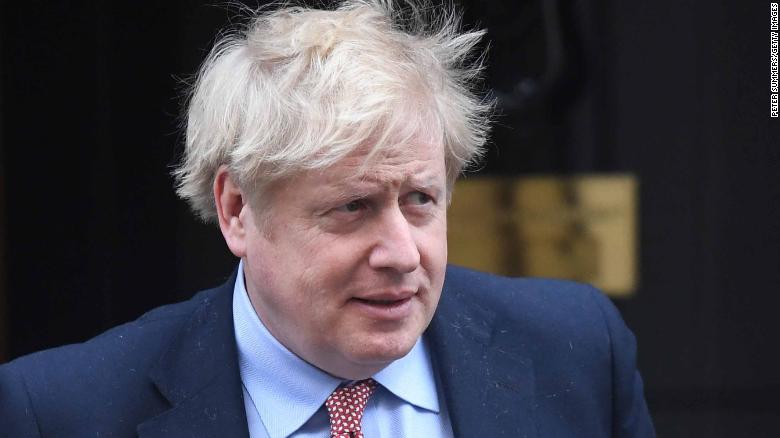
When British Prime Minister Boris Johnson was released from hospital on Sunday, the country breathed a collective sigh of relief. And with good reason — despite officials’ daily insistence that Johnson was in “good spirits,” Johnson himself has since admitted that his life was in the balance.Questions over whether Downing Street was fully transparent about the Prime Minister’s health will doubtless dominate the British media in the days to come. But while important, they risk overshadowing the true picture of the UK’s struggle against coronavirus.Jeremy Farrar, a member of the Scientific Advisory Group for Emergencies (SAGE), put it starkly when he told the BBC’s Andrew Marr program on Sunday that the UK is “likely to be one of the worst, if not the worst, affected countries in Europe”.
Only a few weeks ago, Britons looked on at the unfolding horror in Italy and Spain. Now, as those two countries appear to be over the worst, the UK is on a similar, grim trajectory. The British government — led by Johnson’s designated deputy, Foreign Secretary Dominic Raab — is facing serious questions about why.
Some health experts are increasingly scathing about the government’s response to the crisis — driven largely by the advice of leading scientists from SAGE.Gabriel Scally, president of epidemiology and public health at the Royal Society of Medicine, believes this has led to an abstract response — one based on numbers and scientific models — rather than traditional principles of public health.”There has been this kind of scientism — an approach of academics gathering data and analyzing it then producing theories to be tested — at the heart of the government’s response,” he says. “In fact, what we needed was to follow good public health practice and listen to the advice from the World Health Organization.”
Boris Johnson is getting better, but the nation he leads is not
Analysis by Luke McGee, CNN
Updated 1634 GMT (0034 HKT) April 13, 2020

Italian newspaper’s obituaries filled 1 page. Now it’s 13.

Australia closes beaches amid coronavirus
How China’s Covid-19 tracking app works
‘Yikes!’ Amanpour reacts to Fox News montage about virus

China lifts 76-day lockdown in city where Covid-19 began
Global food supply chain at risk due to pandemic
Ecuador distributes cardboard coffins to cope with Covid-19

Boris Johnson in ICU, Raab deputized to step in as needed

Boris Johnson grateful after release from hospital

Why Greece is coping with Covid-19 better than Italy

China adds restrictions to Covid-19 research and publication
Japan’s Shinzo Abe promotes anti-flu drug to treat virus

Some world leaders ignore officials’ warnings about Covid-19

Hear from residents in Wuhan about life after lockdown
Life in lockdown: tips from around the world

Italian newspaper’s obituaries filled 1 page. Now it’s 13.
Australia closes beaches amid coronavirus
How China’s Covid-19 tracking app works
‘Yikes!’ Amanpour reacts to Fox News montage about virus

China lifts 76-day lockdown in city where Covid-19 began
Global food supply chain at risk due to pandemic
Ecuador distributes cardboard coffins to cope with Covid-19

Boris Johnson in ICU, Raab deputized to step in as needed
Boris Johnson grateful after release from hospital
Why Greece is coping with Covid-19 better than Italy
China adds restrictions to Covid-19 research and publication

Japan’s Shinzo Abe promotes anti-flu drug to treat virus
Some world leaders ignore officials’ warnings about Covid-19
Hear from residents in Wuhan about life after lockdown
Life in lockdown: tips from around the world
Italian newspaper’s obituaries filled 1 page. Now it’s 13.
London (CNN)When British Prime Minister Boris Johnson was released from hospital on Sunday, the country breathed a collective sigh of relief. And with good reason — despite officials’ daily insistence that Johnson was in “good spirits,” Johnson himself has since admitted that his life was in the balance.Questions over whether Downing Street was fully transparent about the Prime Minister’s health will doubtless dominate the British media in the days to come. But while important, they risk overshadowing the true picture of the UK’s struggle against coronavirus.Jeremy Farrar, a member of the Scientific Advisory Group for Emergencies (SAGE), put it starkly when he told the BBC’s Andrew Marr program on Sunday that the UK is “likely to be one of the worst, if not the worst, affected countries in Europe”.
Only a few weeks ago, Britons looked on at the unfolding horror in Italy and Spain. Now, as those two countries appear to be over the worst, the UK is on a similar, grim trajectory. The British government — led by Johnson’s designated deputy, Foreign Secretary Dominic Raab — is facing serious questions about why.Some health experts are increasingly scathing about the government’s response to the crisis — driven largely by the advice of leading scientists from SAGE.Gabriel Scally, president of epidemiology and public health at the Royal Society of Medicine, believes this has led to an abstract response — one based on numbers and scientific models — rather than traditional principles of public health.”There has been this kind of scientism — an approach of academics gathering data and analyzing it then producing theories to be tested — at the heart of the government’s response,” he says. “In fact, what we needed was to follow good public health practice and listen to the advice from the World Health Organization.”In the early stages of the pandemic, the UK was something of an outlier compared to its European counterparts, especially in the areas of testing and social distancing measures. Unlike some other states, the UK appeared slow to increase its testing capacity, and reluctant to impose the kind of social distancing measures that were swiftly put in place elsewhere. “I find it amazing that testing, contact tracing and isolation was not part of any of the scenarios that any of the expert advisers on this group discussed,” Scally says.It has been barely a week since the UK announced plans to increase its testing capacity to 100,000 by the end of April, after even Johnson loyalists criticized the UK’s approach to testing compared to countries like Germany. As of Monday morning, the most recent number was 18,000 tests in a 24-hour period, according to the government.


 NewsAnnexOnline