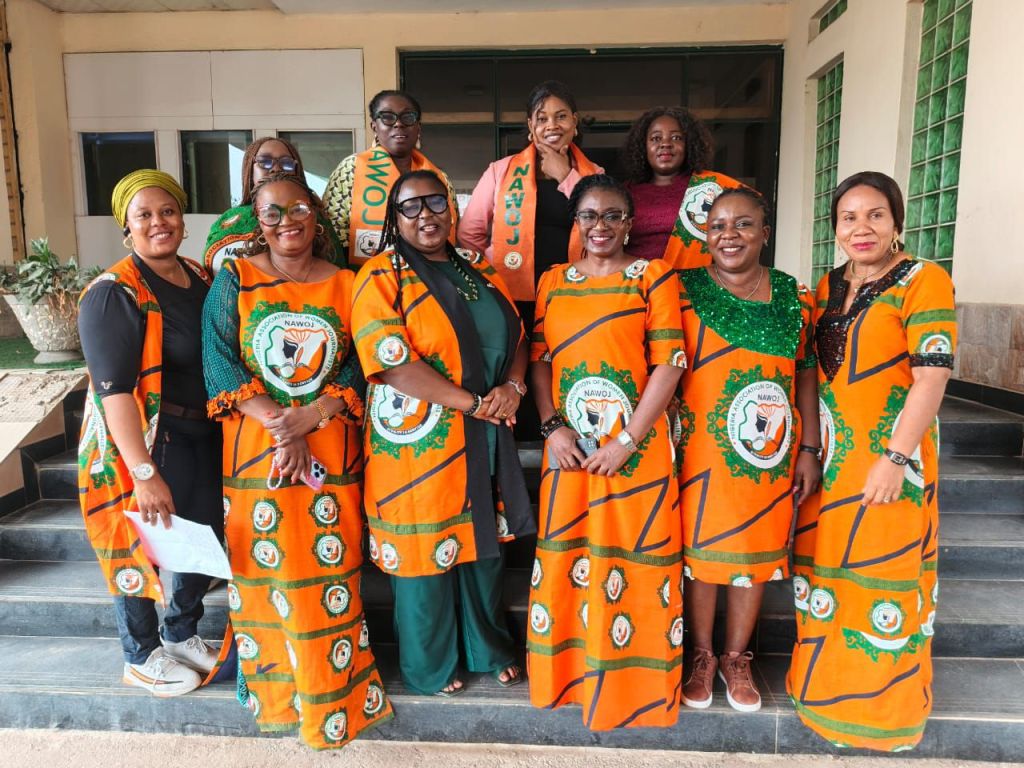
The need to amplify women’s voices by empowering them economically has been underscored.
The Vice- President Nigeria Association of Women Journalists, Zone D, Comrade Chizoba Ogbeche brought this to the fore during a courtesy visit to the Agricultural Research Council of Nigeria to discuss collaboration to empower women in the area of Agriculture.
Drawing attention to the large number of women involved in agriculture, the Vice-President lamented that due to prevailing circumstances, they mostly engage in subsistent and small scale agriculture.
“We have found out that most women farmers are not in large-scale farming. Some of this is because they lack capital, and some because they do not have access to information—especially research-based information on improved seedlings and better farming methods that can help them move into large-scale farming.
“Our visit here today is because we cover six states and the FCT in the North Central. We work with women in these states, and we have encountered many of them complaining that despite farming, what they produce can barely feed them. We know that if they have opportunities for more training and better information—on improving seedlings and other methods—and even access to capital, it can help them”.
She highlighted the role NAWOJ plays in amplifying the voices of vulnerable persons
“We decided to focus on women, the vulnerable, the less privileged, and persons with disabilities—those who do not have voices, so we can amplify their voices. NAWOJ is now involved in amplifying gender issues, including ongoing advocacy around special seats and gender-based violence.
” We are talking about an opportunity to help amplify agricultural research for gender-responsive food security in Nigeria.
“Our mission here today is to seek areas where we can partner to provide more information for these women, especially those interested in farming, so that they can do it the best way. The problem is not that the information is not there. Some of them are not educated, and many of the materials are in English. We want a situation where we can take this information to them in their local languages, explain it in a non-academic way, and make them understand based on their real problems and the solutions provided by research”.
She expressed optimism that the success of the programme, will have more women moving from subsistence farming to large-scale or commercial farming as well as contribute towards diversifying the Nigerian economy by moving away from oil.
Responding, the Executive Secretary, Dr. Abubakar Adamu Dabban represented by Dr. Nuhu Yusuf, Director, Knowledge Management and Communications described the proposal as laudable and a very valuable initiative. He further said it is in line with the New Hope agenda of Mr President.
He gave assurance that a committee would be set up to come up with a plan for implementation of the proposal.
“From your side, you are from different media houses, with radio and TV. Apart from publishing some of our methodologies and farming practices that will help the public, you can also help us reach farmers in the cities who can engage in large-scale farming. You can help us create space in your publications to reach out. We have researchers who can write in simple language.
We have 16 research institutes and 17 agricultural colleges around the country. We can come up with simplified methodologies so the public can understand and put them into practice”.
Dr Yusuf said the main problem of the council is dissemination of information noting that they have a lot of research, and a lot of money has been spent by the government.
He further noted that the researchers have done a lot of work citing an example in the FCT where they had a programme where they engaged AMAC and Bwari.
” We adopted some villages and established what we call “adopted villages.” We built centres, equipped them with audio-visual materials, CDs, chairs and tables, and handed them over to farmers. We followed them up—going every week or twice a week with our researchers. We also had demonstration farms.
“We would bring their local yam varieties and our five improved varieties. After harvest, we showed them the difference from the same crop and the same treatment. That is how they began to adopt our varieties. This is in the FCT alone, by ARCN”.
He buttressed his point on poor dissemination by citing their institutes with mandates on rice, sesame seed and others where they have over 16 varieties of rice, and many people are not aware.
On his part, Dr. Oluwafemi Salako, Director, Plant Resources, ARCN who expressed pleasure at the visit said there is a need to help women in agriculture noting that in many interventions, men are considered first.
“Women often need permission to attend, and if the husband does not agree, that is the end of it. This has made women less visible in many programmes, except in areas traditionally associated with them”.
Meanwhile, the Director Extension,Duropitan Isaiah pointed out that the problem of low adoption is not that the information is not there, but that people are not aware of it. He pointed out that some of them are also afraid to take risks, so they need a lot of guidance and reassurance to show them that these are real breakthroughs that can make their agriculture more effective.
“If you look at the efforts of this council, even in creating agricultural research centres, including in the FCT, they are supposed to have a big impact, but many farmers still see our interventions as something they do not want to get into so we need to give them more information and also show practical examples of success on these crops”.
The Vice-president Zone D was accompanied by the secretary FCT Council, Nkiruka Nnoli, Assistant Secretary FCT Laraba Murray, Internal FCT Mnenna Iorkegh and some other members of NAWOJ.


 NewsAnnexOnline